Ocean Acidification and its Effect on Blue Crabs
As the Bay has become more acidic, the blue crab population has declined, as you can see in these graphs.
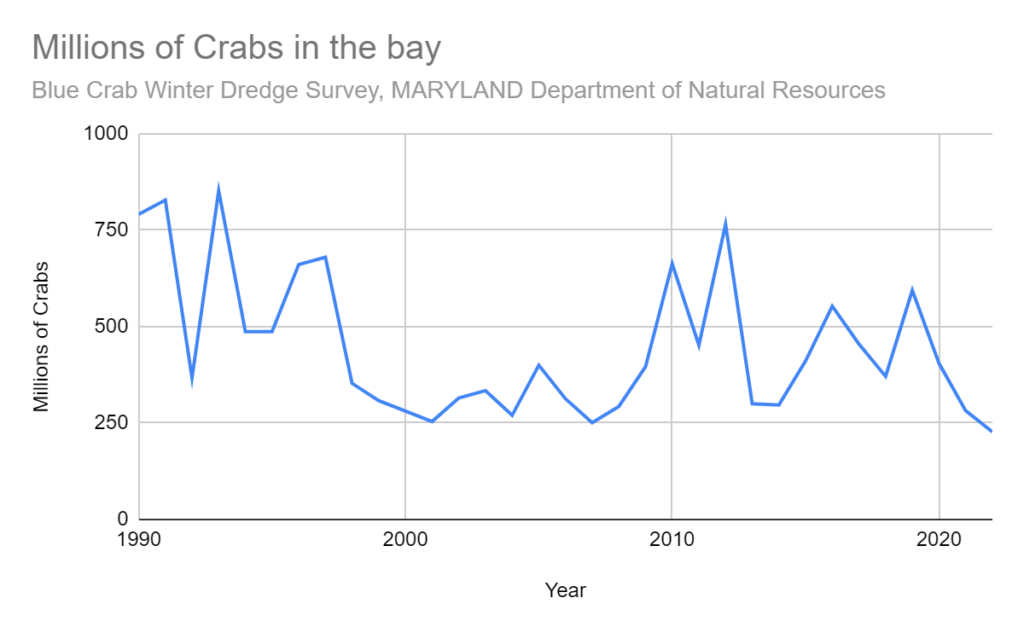
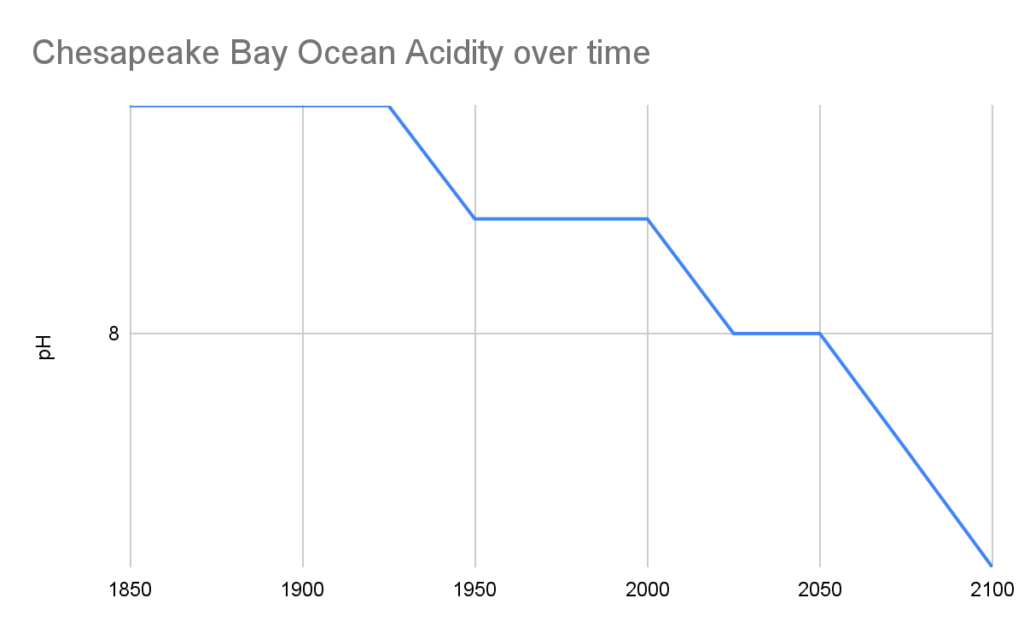
Blue crab population has been on the decline since 1990. There were sharp upticks in 2010 and 2012 but 2022 was the lowest population recorded.
One way that acidification affects blue crabs is by weakening its shell, at least in the short term. According to American Oceans:
An influx of carbon pollution to the waters will eventually cause Blue Crabs to grow larger shells. In turn, the Blue Crabs will become larger and, therefore, more aggressive predators. (Blue Crabs: Facts, Diet, & Habitat Information)
This could happen in the long term, but in the short term it isn’t. Blue crab shells are actually being eaten away at by the more acidic ocean. Eventually, that could cause them to start producing larger shells, but only if they survive long enough for that to happen. New research has also shown that baby crabs are more likely to die before they reach adulthood under acidic conditions (Blue Crab Blues)
“Blue crabs serve many important roles in the Bay food web. As larvae they are preyed upon by numerous filter-feeders, such as menhaden. As they grow older, crabs feed upon a variety of smaller bivalves that live on the Bay floor. Eventually, many crabs are then preyed upon by larger fish and birds. Some of the more common Bay species that eat blue crabs include red drum, croaker, blue catfish and cobia. In fact, cobia are such voracious predators of blue crabs they are sometimes referred to as “crabeaters.”. And, yes, the tales of cannibalism are true—blue crabs will eat other blue crabs.”
Blue crabs – Chesapeake bay foundation
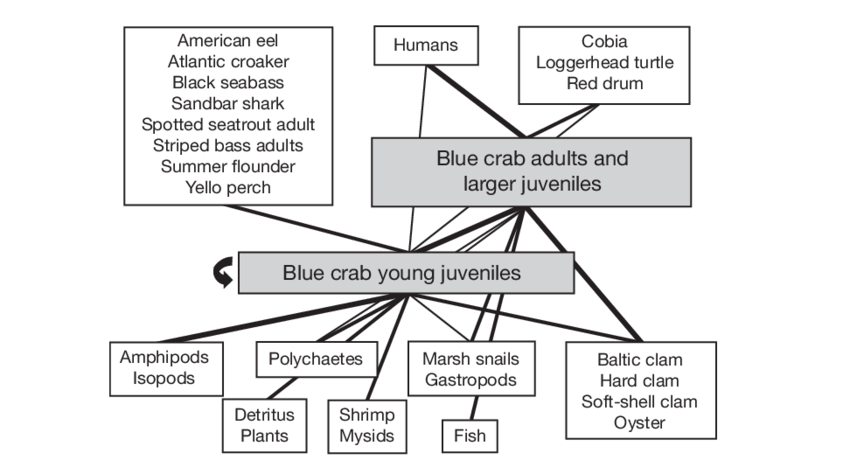
Blue crabs are essential to the Chesapeake Bay food web. A food web a diagram of organisms that shows what each one eats and what eats it. Both adult and young blue crabs are a food source for larger animals as well as for other blue crabs. As this food web shows, the loss of the blue crab would not only have devastating effects for humanity, it would also have a devastating affect on the entire Chesapeake Bay ecosystem.